Showing posts with label citrus curd. Show all posts

Sunday, November 16, 2008

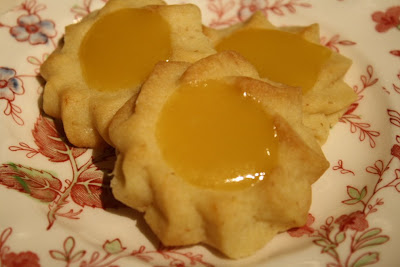
Buttery Thumbprints with Citrus Curd

Candying lemon and orange peel led to lemon-orange curd and making curd necessitated the baking of cookies on which to put said curd. So, of course, I obliged.
I work in a food co-op in the part of the store where the magazines are displayed. It being a food co-op, nine tenths of the magazines are food related (the other tenth is split between yoga and politics) and a constant temptation. Now that the holidays are upon us, nine tenths of the nine tenths of the magazines are devoted to cookies. It was more than I could bear. Luckily for me, at the moment I was giving way to temptation, about to buy The Best of Fine Cooking: Cookies, my mom came in and bought it for me.
I adapted their recipe for Orange Cream Stars, a sandwich cookie composed of a delicious sounding, although as yet untried, orange butter cream sandwiched between two buttery star-shaped cookies. I didn't use the orange cream because the whole point of the endeavor was to use my citrus curd. As I said in my post on curd, I felt as though the curd could have gone a little longer, been a little thicker, so and I didn't think it would stand up to being sandwiched. I thought instead, thumbprints! So instead of Orange Cream Stars I made Lemon Cream Cheese Thumbprints with Citrus Curd.
For the cookies:
3 oz. cream cheese, softened
1/2 lb. unsalted butter, softened
1 cup granulated sugar
1 Tbs. freshly grated orange zest (I used lemon zest)
1 large egg yolk
1 tsp. pure vanilla extract
12oz. all-purpose flour (My co-op has organic unbleached white flour with germ, which acts like 'regular' white flour but lends a pleasant nutty flavor to whatever you bake with it.)
Beat the cream cheese, butter, sugar, zest, yolk, and vanilla until fluffy, then add the flour gradually. I would recommend using a stand mixer.
To make stars pipe the dough onto a cookie sheet lined with parchment using a 1/2-inch star tip. To make the thumbprints I mashed down the stars' tips with a buttered 1/2-tsp. measure. They don't spread much, so you can put them quite close together.
Bake the cookies in a 350-degree oven until the edges begin to brown, about 20 minutes.
Set the cookie sheet on a rack until the cookies are cool enough to remove with a spatula without distorting their shape.
Once the cookies were cool I filled their dimples with curd. At first the curd seem too runny. I bit into a cookie and the curd started running down the side and down my front and onto the floor. After a few hours, though, the curd set up quite nicely and hopefully didn't cause my coworkers, the lucky recipients, any embarrassment.
Friday, November 14, 2008

Lemon-Orange Curd

Having candied the peel of two lemons and two oranges, I was left with four naked citrus fruit. They would not last long in that vulnerable state so I had to do something with them. Forget lemonade. When the world gives you naked citrus, make curd!
For the recipe I turned to one of my favorite cookbooks, The Farmhouse Cookery: Recipes from the Country Kitchen. The great thing about this cookbook is that the recipes call for so little and deliver so much. You can have a pinch of flour, an egg, an apple, some sugar, and, y'know, salt and you'll find a recipe that provides dessert for 4. One of my standbys is the plum sponge, which can be made with almost any fruit--whatever happens to be in season. The recipes also come with a bit of history.
Lemon or Orange Curd
Countrywide
Lemon curd seems to be descended from the curd tarts of the early 17th century that were known as cheesecakes. Their fillings were composed of curds, eggs and spices.
Later in the century, as lemons became more widely available, the lemon cheesecake, filled with a mixture of pounded lemon peel, egg yolks, sugar and butter, came into vogue. Orange cheesecake was also made from the peel of Seville oranges, which was first boiled two or three times to reduce the bitter flavour.
But more than 200 years were to pass before it occurred to anyone that the filling might be delicious if spread on bread and butter.
Preparation Time: 20 minutes
Cooking Time: 30-40 minutes
Ingredients to yield about 1.5-2 lb.
Juice and finely grated peel
of 3 large or 4 medium lemons
(or oranges)
8 oz. butter
1 lb. caster sugar
5 eggs, beaten
Place the juice and finely grated peel in the top of a double saucepan or in a bowl over a saucepan of boiling water. Add the butter and caster sugar and stir gently over a low heat until the sugar is completely dissolved.
Take the pan from the heat and strain in the beaten eggs.
Put back over over a low heat and cook gently until the mixture coats the back of the spoon, stirring occasionally. Pot and seal.
This curd has a shelf life of 2 weeks, but will keep for up to 1 month in the refrigerator.
So that's the recipe I followed. Since I had already removed all the peel and used it for something else, I couldn't use it in the curd, but I don't think the curd suffered that much for lack of it. I was afraid of cooking my eggs because my juice-butter-sugar mixture had gotten quite hot, so before straining the eggs into the juice I put some of the juice in the eggs to let them get used to the temperature. Nobody likes being thrown into a too hot bath. As for the cooking time, I think it took more like an hour for my curd to thicken and I probably could have cooked it a little longer. So if it's been 40 minutes and you're still not there, don't despond just let it go longer. I figure a lower heat and more time and not cooking your eggs is far better than quickly thickened grainy curd. It's always nice to have a jar of curd in the fridge. It is great for instant desserts. You can make tarts, put it on cookies, spread it on toast, or just bread with lots of butter. Or even just eat it by the spoonful.